








The difference between ceremonial cacao vs. chocolate - even raw chocolate
What is it about ceremonial grade cacao that distinguishes it from chocolate – even raw chocolate and powder?
In this text, you will learn about:
- The creation of chocolate vs. ceremonial cacao
- The 2 major differences between ceremonial cacao and chocolate
- Which bean is considered the right bean for ceremonial cacao
- What loving gifts ceremonial cacao has for you
Ceremonial Cacao: A tribute to tradition and love for Ixcacao (the spirit of cacao)

The first big difference comes here
A customer once told me that it was like separating a mother from her child by letting chocolate undergo this process. It stuck with me, as this is precisely what makes chocolate incomparable to the effect of ceremonial cacao on the physical, emotional and spiritual.
However, there is something energetic missing that raw chocolate and raw cacao powder cannot replace in any way, even when produced at lower temperatures.
The second big difference comes here
The second major difference between ceremonial cacao and chocolate is perhaps more comprehensive than just one single thing. But the essence of the difference is precisely one thing: it is the energy behind the ceremonial cacao - from farm to table.
Deep connection to the spiritual
Very often, I thank Ixcacao (cacao spirit) for the immense gift she is, from Mother Earth.
I thank the people behind it who made it possible to bring cacao to me.
I thank the people whom I don't know with my conscious mind, but whom my heart knows, for preserving cacao, honoring her, and carrying her wisdom through generations.
The reason I mention this is to provide insight into how the energy behind ceremonial cacao helps awaken that love within you, as many of the people involved possess this love for cacao.
It is the love and reverence for cacao as a spirit – from the very beginning of the tree until you sit with your cup. This is an entire section in itself! But my invitation to you is how you can carry this forward into your own rituals with ceremonial cacao – or if you hold cacao ceremonies?

Which bean is used also matters
- Criollo is considered the sacred cacao bean
There are 3 different types of cacao beans. The first two are Criollo and Forastero, often referred to as the "original" beans.
But there is also the Trinitario variety, which is a hybrid of the two types of beans, as well as other variants, but these are not widely used.
The Criollo cacao bean is considered the finest variety due to its rarity and taste. Therefore, it is also the most expensive, as it requires more effort than Forastero, which is often the variety used by large chocolate producers. It is estimated that at least 85% of chocolate production uses the Forastero cacao bean – probably because it is easier to work with and therefore results in lower costs.
The Criollo cacao bean is the variety that has been used for ceremonial cacao for thousands of years. So, if we were to pick one bean as the right one for ceremonial use, the choice would undoubtedly fall on the Criollo bean.
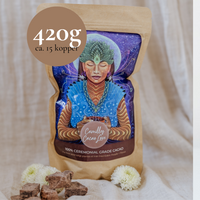
That's why criollo is used to create Camilles Cacao Love
That is why it is important for me that the criollo bean is the one used for Camilles Cacao Love - even if the price is higher. But to honor the traditions that have existed for thousands of years, as well as the intensity of taste, which also affects the energetic effect that many experience when enjoying Camilles Cacao Love.
Therefore, you will also be able to feel the difference in the effect of ceremonial cacao
- but what is it about her?
I write "her" because she is considered a feminine spirit. She is referred to by the Maya people as Ixcacao (pronounced: ish-ka-ka-uw). The prefix "Ix" is used to indicate that it is a feminine spirit.
Chocolate carries energetic notes of the effect you will experience with ceremonial cacao, as she is often referred to as a woman's "go-to" for menstrual pain, for embracing one in need of comfort (for comfort eating, for example) and all the hype around chocolate, which is almost an elite sport in gastronomy.
However, chocolate is primarily for the taste buds, while ceremonial cacao will create a connection to your soul. She is referred to as "the energetic heart's medicine" (not to be confused with allopathic medicine, i.e., modern medicine), but I refer to her as the soul's medicine because she embraces you, is your resource for something higher and greater than yourself, and increases awareness of your feelings, connection to yourself and the world around you.

If you have more questions or want to read more, you can delve deeper into the world of cacao via the FAQ or find more inspiration on the Cacao blog
Otherwise, you are most welcome to write to me in the chat (bottom right corner) or send an email to ordre@camillescacaolove.com