










Nutrition in one cup of cocoa 🤎 (28g)
When nourishment, connection, and consciousness meet
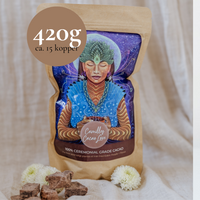
As you sit with your cup of Camille's Cacao Love, I want you to intentionally absorb the nourishment. Not only emotionally and what the cacao does for you in your inner work, but also to absorb the nourishment into your physical body, so you can feel like your own medicine woman – who can drink a cup of cacao when you feel your physical body needs support – for a cold, stress, during your menstruation – or when you simply want to pamper your body.
For many, ceremonial cacao is a plant you connect with.
A moment where the pace slows down, and the body is allowed to land.
But cacao is also an exceptionally nutrient-dense food.
And when the body – the home of the soul – is nourished, it often creates more calm, stability, and clarity. Emotionally, mentally, and thereby also in the inner, spiritual space. To the cosmic layer that reminds us that we are all connected. We are all one.
Therefore, it makes sense for me to talk about cacao both as relationship and reality.
Here, I share what one cup of ceremonial cacao, approximately 28g, actually provides – and how it can be put into perspective.
Magnesium – calm, nervous system, and inner resilience
Approx. 98 mg per cup of cacao (28g)
Magnesium is involved in several hundred enzymatic processes in the body and plays a central role in:
• Normal function of the nervous system
• Muscles' ability to relax
• Energy metabolism and fatigue
• Heart rhythm and stress response
Many people lack magnesium, especially with stress, high activity, or an irregular diet.
In cacao, magnesium is naturally found together with fats and fibers, which is often experienced as more balanced than isolated forms.
Facts in perspective:
– 98 mg of magnesium is roughly equivalent to the content in 30–40g of pumpkin seeds
– A common multivitamin (e.g., Nani) contains approx. 50 mg
– OmniMin typically contains 50–100 mg depending on the dose
– Coffee contains only small traces
– Matcha contains approx. 5–10 mg per cup
Potassium – fluid balance and electrical flow
Approx. 308 mg per cup of cacao
Potassium is important for:
• Fluid balance
• Muscle and nerve signaling
• Normal regulation of blood pressure
Potassium works closely with sodium and is crucial for the body's electrical flow.
Facts in perspective:
– 308 mg of potassium is roughly equivalent to a large banana
– Most multivitamins contain very little or no potassium
– Coffee contains approx. 100 mg per cup
– Matcha and green tea contain only small amounts
Iron – oxygen, energy, and vitality
Approx. 2.2 mg per cup of cacao
Iron contributes to:
• Normal oxygen transport in the blood
• Energy level and endurance
• Cognitive function
Cacao provides plant-based iron as part of the whole – along with fiber and polyphenols.
Facts in perspective:
– 2.2 mg of iron is roughly equivalent to 100g of spinach
– Nani multivitamin: approx. 2.4 mg
– OmniMin: approx. 5–10 mg depending on the dose
– Coffee and matcha contain very little iron
Zinc – immune balance and cell renewal
Approx. 1.3 mg per cup of cacao
Zinc plays a role in:
• Immune function
• Skin, hair, and nails
• Hormonal balance
• Wound healing and cell division
Facts in perspective:
– 1.3 mg is roughly equivalent to a small handful of nuts
– Nani: approx. 4 mg
– OmniMin: approx. 6–12 mg
– Coffee and matcha contain only traces
Copper – connective tissue and iron metabolism
Approx. 0.6 mg per cup of cacao
Copper contributes to:
• Normal iron metabolism
• Connective tissue strength
• Nervous system function
Facts in perspective:
– 0.6 mg is a significant amount from one food
– Nani: approx. 0.4 mg
– OmniMin: approx. 0.25–0.5 mg
– Coffee and matcha contain only minimal amounts
Polyphenols – plant protection and body support
Approx. 1,300 mg per cup of cacao
Approx. 4,600–5,600 mg per 100g
Polyphenols are antioxidants that the plant produces to protect itself – and which, in the body, contribute to:
• Protection against oxidative stress
• Support for circulation and cells
• An experience of clarity and vitality
Cacao is among the most polyphenol-rich foods we know – especially because we consume the entire plant and not an extract.
Facts in perspective:
– 1,300 mg of polyphenols is roughly equivalent to:
• 250–300g blueberries
• 2–3 cups of strong coffee
• 5–7 cups of green tea
• 6–8g ceremonial matcha
Matcha is very rich per gram – but the portion size is significantly smaller than cacao.
Fiber – grounding and digestive calm
Approx. 4.3g dietary fiber per cup of cacao
Fiber contributes to:
• Satiety and stable energy
• Healthy gut function
• Blood sugar balance
Facts in perspective:
– 4.3g of fiber is equivalent to a small portion of oatmeal
– Coffee and tea contain 0g
– Matcha contains only very small amounts
Protein – satiety & nourishment
Approx. 3.8g plant protein per cup of cacao
Protein contributes to:
• Building and maintaining tissue
• More stable satiety
Facts in perspective:
– More than in coffee, tea, and matcha
– Not as high as legumes – but meaningful as part of the whole
Caffeine & theobromine - stable energy without crashing (at least for cacao)
Cacao contains both caffeine and theobromine, but in a way that the body experiences differently than coffee:
Theobromine (approx. 293 mg per cup of cacao): has a mild stimulating effect, supports the heart, and provides smooth, gentle energy without the sudden spike that coffee often gives. Many people find they can maintain focus and simultaneously feel calm in the body.
Caffeine (approx. 37 mg per cup of cacao): lower than in coffee, which means less risk of restlessness or a "crash" afterwards.
Comparison:
Coffee: approx. 80–120 mg caffeine per cup → provides quick energy, but the body can experience a subsequent drop in energy (crash).
Ceremonial matcha: approx. 60–70 mg caffeine per cup → more stable than coffee, but still higher than cacao.
A summary
Ceremonial cacao is not just something you drink.
It is something you can enter into a relationship with.
And at the same time, it is a food that genuinely nourishes the body – with minerals, fiber, fat, and plant compounds in their natural form.
When the body is nourished, you have greater emotional and mental surplus, and thus the capacity to expand your spiritual relationships and abilities.
And there, connection, stillness, and inner work can find more space.
🤎

Written by Camille Ingvild



Leave a comment
This site is protected by hCaptcha and the hCaptcha Privacy Policy and Terms of Service apply.